

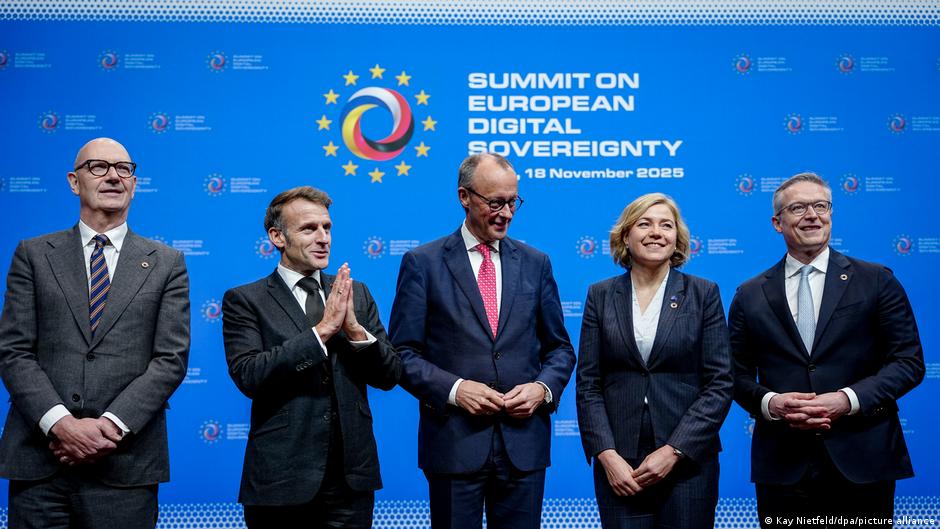
European Digital Sovereignty Summit
The joint participation of French President Emmanuel Macron and German Chancellor Friedrich Merz in an event in Berlin to strengthen Europe’s technological independence suggests that they are serious about the issue. Europe’s difficulties in keeping pace with the United States and China in technical and digital innovations – from artificial intelligence to semiconductor production to cloud computing – are blamed for the continent’s sluggish economic growth and seemingly bleak outlook.
The Risks of Dependence
The Berlin meeting, titled “European Digital Sovereignty Summit,” focused on the risks of dependence on China and the United States for increasingly critical infrastructure. “Digital sovereignty has costs, but the costs of digital dependence are even higher,” Merz said, while Macron said he did not want Europe to be a customer of the US or China or a “vassal”. “We clearly want to develop our own solutions,” he said.
Made in China
One of the areas where Europe is particularly dependent on China is the infrastructure it uses for its telecommunications networks, from companies like Huawei and ZTE. "They had very few competitors and alternatives, and most alternatives are much more expensive," Ilaria Mazzocco, deputy director of the Board of Trustees for Chinese Economics and Business, said. However, according to a report, it increasingly appears that the European Commission is looking for ways to force EU member states to exclude Huawei and ZTE from their networks.
The European Commission’s Stance
The European Commission recommended that member states take measures to prevent “high-risk providers” from being integrated into their new 5G internet networks. However, no legal requirement has been made. The Commission Vice President now wants to convert this recommendation into a legal obligation. A spokesperson for the European Commission said they were “urging” member states to implement the recommendations as “the lack of rapid action puts the EU as a whole at clear risk”. The EU’s willingness to crack down on Huawei was demonstrated by its decision to ban Huawei lobbyists from meeting European Commission officials.
The German Government’s Plan
Chancellor Merz is preparing the ground for stricter legislation. “We have decided within the government that we will replace components, for example in the 5G network, with components from our own production wherever possible,” he said. “And we will not allow any components from China in the 6G network.” The German business daily newspaper reports that the federal government has agreed to stricter legislation to make it easier to remove components deemed a safety risk.
The True Meaning of Technical Sovereignty
Richard Youngs points out that current European attempts to achieve “technology sovereignty” are complicated by the fact that European governments have different expectations of the concept. “Some focus mainly on the competitiveness aspect, others on the security aspect, still others on the development of a public model for digital technology,” he said. The security element is legitimate, but competitiveness is probably the strongest driver at the moment.
Difficult Conversations
With the European Commission now apparently ready to take a much tougher stance against Huawei and ZTE, the possible consequences for Europe of excluding these companies are being considered. Lars Klingbeil, the German finance minister, is visiting China and the topic of the possible exclusion of Chinese technology from German telecommunications networks will certainly come up. “Beijing won’t like this,” says Mazzocco. "I think that would be very damaging for Huawei. And Huawei is a very important company for Beijing right now."
The Path Forward
If Europe moves forward with a legal ban on Huawei and ZTE, there will be more focus on viable alternatives. Member states could tap home-grown European companies such as Finland’s Nokia and Sweden’s Ericsson to help develop new networks, but the costs would be far higher than those of Chinese rivals – a tough sell at a time when many European governments are mired in heavy public debt and struggling to boost sluggish growth. “It’s up to Europe to actually come up with a plan to make sure it doesn’t cave under the pressure and put in place regulation that it can realistically implement and then withstand any pressure from China,” Mazzocco says.
