

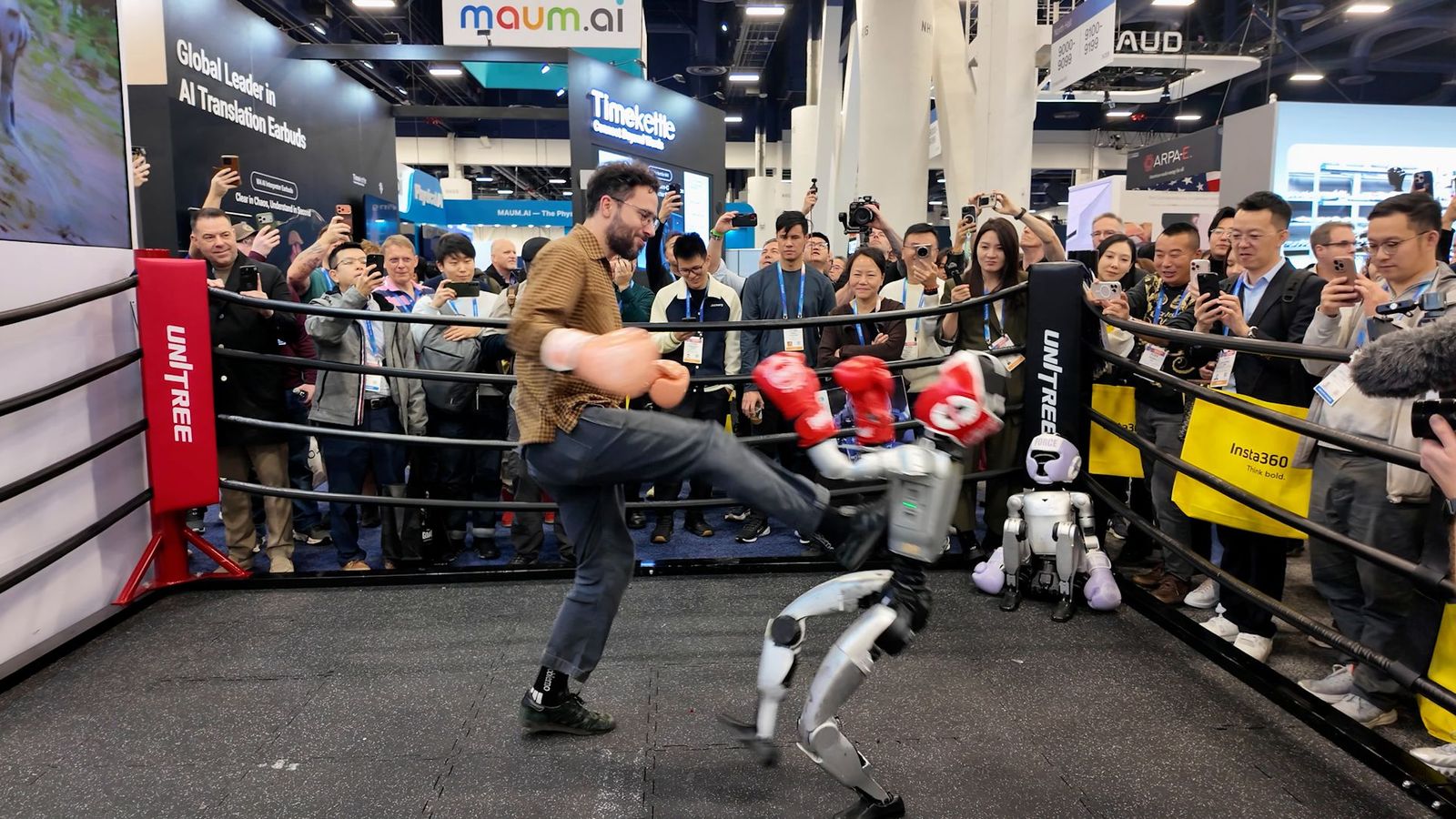
My First Fight with a Robot
The experience started badly. I hit my chest hard and felt a shaking sensation run up my arm. It was like hitting a brick wall. Once I started kicking it, it got better. I gave him a hard push with my foot and he staggered back into the ropes of the ring.
The Robot’s Limitations
At this point, a person might have given up, but robots are tireless. It immediately jumped back up, ready for further punishment. The robot had no chance to fight. Chinese robotics company Unitree invited me to battle one of its G1 units live on stage at the Consumer Electronics Show (CES) in Las Vegas. The event was organized as a demonstration of the robot’s ability to work with humans. It had no chance of defeating me or even landing a blow.
Assessing the Robot’s Strengths and Weaknesses
After recovering from the battle, I was able to assess the strengths and weaknesses of the technological achievement I had just witnessed. Balance is difficult for robots, but the G1 managed to stand back up even after a hard kick. What he lacked was agility. It wasn’t able to dodge my blows like a human could. Partly this was intentional – Unitree wants people to enjoy the experience, which means letting them win.
The Challenge of Creating Humanoid Robots
At the same time, however, this reveals a fundamental technological challenge that every humanoid robot manufacturer faces: to make a robot nimble and light-footed, it must be equipped to deal with unexpected instability. People don’t just balance – we rethink the task in the middle of the movement. Most robots are still figuring this out. The question of balance could represent the entire field of robotics.
The Future of Robotics
I came to CES to find out the truth about robots. The hype about physical activity AI is almost overwhelming, and not without reason – the success of self-driving cars shows that machines can be taught to perform just as well, if not better, than their human counterparts. We will have robots with human abilities “this year”, but the fantasy of the robot butler rushing around the house to complete all the tasks is still a long way off, simply because human bodies and behaviors are so difficult to replicate.
Advances in Robotics
One of the most impressive technological achievements I saw during my visit to CES was a robot that folds laundry. The awareness and dexterity required to handle soft materials has always been alien to robots. However, when I examined the laundry folding robot more closely, I discovered that it had to be remotely controlled for four days to get used to the new table and lights in the unfamiliar CES environment.
The Challenges of Replicating Human Abilities
Everywhere you look, you can see both how far robots have come and how far they still have to go. Over the past few days, I’ve seen dozens of robotic hands attempting to recreate all the different facets of the incredible tool we were gifted at birth. Touch, for example, is something engineers try their best to reproduce by attaching tactile sensors to the robot’s fingers. Or the way human fingers have a certain degree of flexibility that allows them to absorb shock rather than fight against it.
The Goal of Reversibility
In robots, the ability to yield rather than stall is known as “reversibility” and is one of the industry’s prized goals. The South Korean company WiRobotics showed me its new actuator – the robot term for muscle – which has integrated force detection that should enable reverse driving. “It can absorb the impact and even use it,” says the founder and CEO of WiRobotics. His robot achieved a rare feat: a handshake that felt human.
The Future of Humanoid Robots
Human hands don’t always give way. We constantly alternate between softness and stiffness – gently reaching for a phone and then bracing ourselves to lift a suitcase. This dynamic switching is the real goal. And at this point, it still feels far away. What has changed is that there is now a way to get there thanks to generative AI. Every roboticist I spoke to agreed: Generative AI has revolutionized the industry. It now looks like humanoid robots are coming here. It just might take a little longer than many people hope and fear.
