

Introduction to the Beethovenhalle
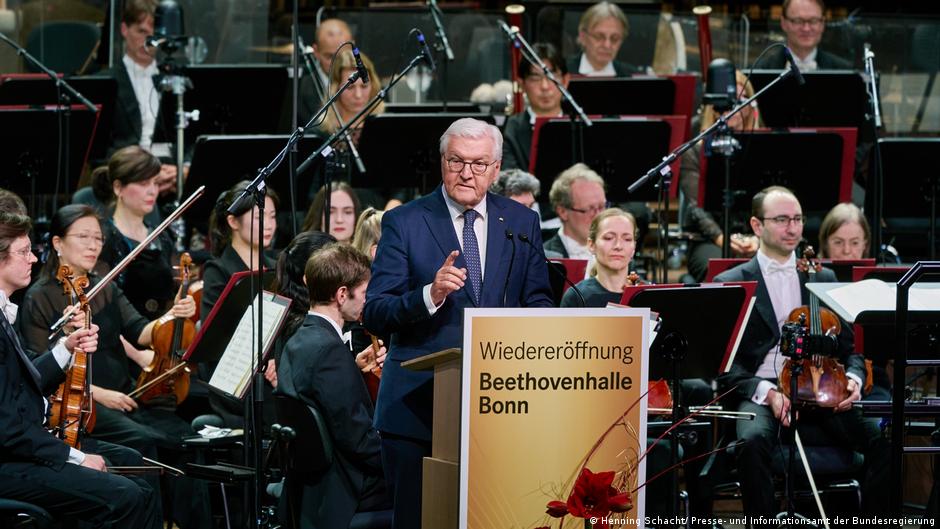
On December 16th, the Beethovenhalle Bonn was reopened after almost 10 years of renovation. The concert hall welcomed the audience with an almost four-hour “Beethoven Night” concert. Federal President Frank-Walter Steinmeier gave the opening speech in front of around 1,600 guests. In doing so, he followed in the footsteps of his predecessor Theodor Heuss, who inaugurated the “courageous and modern building” in September 1959.
A Place of Democratic History
At the opening of the renovated venue, Steinmeier emphasized that the Beethovenhalle was not just dedicated to Bonn’s most famous son and his music. “It is also, and you can imagine that this is particularly close to my heart, a place of democratic history.” This democratic history began after the Second World War. Germany was in ruins – destroyed, divided and internationally isolated. How could the country start again? The Western Allies demanded that the German leadership create a new democratic order and form a republic that citizens could trust. But which of the destroyed cities could serve as the seat of government?
The Choice of Bonn
After a long debate, the choice fell on Bonn, a small university town on the Rhine in the west of the country – and also the birthplace of Ludwig van Beethoven. Bonn was unprepared to function as a capital and residents had to improvise. The Parliamentary Council met for the first time in the Natural History Museum, surrounded by stuffed animals and prehistoric artifacts. There was also no concert hall: the municipal Beethoven Hall from the 19th century was destroyed in a bomb attack in 1944.
The Architectural Design
However, a new building was already planned. The architect was 29-year-old Siegfried Wolske, who won the 1954 design competition from 100 entries. “Wolske was one of those very young, motivated, creative people who represented the desire for a new beginning in a new Germany, in a young democracy,” says architectural historian Constanze Falke. Wolske was drafted into military service at the age of 18, taken prisoner of war, and upon returning home, completed his high school diploma at the age of 21 before beginning his studies.
The Construction of the Beethovenhalle
After three and a half years of construction, the hall – simple, comfortable and elegant – was completed and handed over to the city. The Beethovenhalle served as the “living room” of German democracy for the next 60 years. Federal meetings, party conferences and, above all, concerts took place here. In the six decades of its existence, more than 15,000 events took place.
A Jewel of Post-War Modernity
Falke describes the Beethovenhalle as a “special feature of post-war modern architecture”. Architecturally, the building is an example of “organic architecture,” a style closely associated with Hans Scharoun. The school of thought that emerged during the Bauhaus era suited the post-war period: away from pomp and rigidity, towards simple functionality that consciously rejected Nazi monumentalism. The hall’s modest exterior contrasts with its detailed interior. The list of materials reads like a travelogue: Italian marble, Swedish granite, precious woods from West Africa and Japan.
The Renovation Challenges
The diversity of the rooms presented major challenges during the renovation. Adapting rooms that were designed in a different era to modern standards took years and cost millions. Ultimately, the total costs rose to over 220 million euros, while Wolske completed the original construction for just under 10 million German marks: about an eighth of that.
The Reopening Concert
Above all, the Beethovenhalle can now regain its original role: as a place where people can experience music. It will once again be the home venue of the city’s Beethoven Orchestra. The works of the long Beethoven Night include Beethoven’s Fourth Piano Concerto, performed by the Bonn star pianist Fabian Müller, as well as a work by the young Croatian composer Sara Glojnaric. The highlight of the evening is Gustav Mahler’s ‘Resurrection’ Symphony, the Second, performed with a wink, but actually only a very small wink. Because this piece is about the things that remain, even if we no longer exist.
