

Introduction to Queen Nefertiti
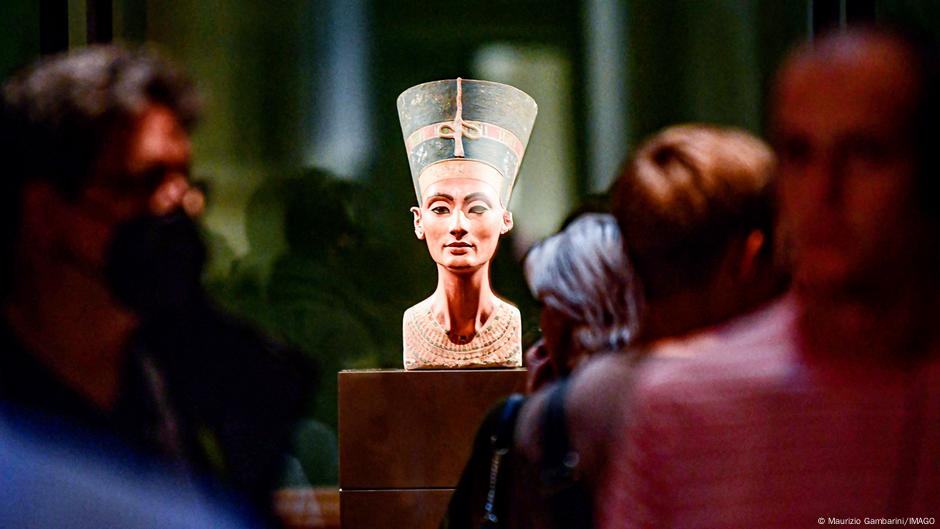
Queen Nefertiti, whose name translates as “The Beautiful One Has Come,” is one of the most famous figures of antiquity. The great royal wife of Pharaoh Akhenaten, who radically changed Egyptian religion by promoting the worship of the sole sun god Aten, reigned more than 3,300 years ago. Nefertiti’s present-day fame is largely due to the discovery in 1912 of a painted, stucco-covered limestone bust by a team of German archaeologists led by Ludwig Borchardt.
The Discovery and Current Location of the Bust
The bust was then brought to Berlin. Today it is “the undisputed star of the New Museum,” as it says on the website of the Prussian Cultural Foundation, which looks after the collection of the museum, which is part of the UNESCO-protected Berlin Museum Island.
Calls for Restitution
Claims for restitution began shortly after the bust was discovered. Now, with the opening of the Grand Egyptian Museum in Cairo, the calls are gaining momentum. Visitors on tours of the Grand Egyptian Museum are being asked to sign a petition initiated last year by former Egyptian Minister of Tourism and Antiquities Zahi Hawass. The petition calls on the German culture minister and the Prussian Cultural Heritage Foundation to address the matter.
The German Response
A spokesman for the German culture minister told DW in a written statement that "Issues regarding the protection of cultural property relating to Egypt, including the bust of Nefertiti, are the responsibility of the Foreign Office." The Foreign Office states that it has “received no request from official Egyptian authorities to return the Nefertiti bust” and that it is “not known that such demands were ever made to the German government.”
The Legality of the Purchase
The Prussian Cultural Heritage Foundation claims that the bust of Nefertiti was found during an excavation approved by the Egyptian Antiquities Administration and that it came to Berlin due to a division of the find. However, Egyptian researcher and heritage activist Monica Hanna disputes this claim, stating that Ludwig Borchardt intentionally and fraudulently downplayed the value of the bust when dividing up the finds.
The Ethical Validity of the Law
German historian Sebastian Conrad adds that beyond the controversial details surrounding the division of the find, the ethical validity of the law itself should be questioned. "It is a law that could only exist under the unequal power relations of the imperialist era, because Egypt was essentially an English colony at the time. That means, in my opinion, that the real question is whether one can legitimately invoke such a law," he told DW.
Attempt at Restitution Blocked by Hitler
Egyptologist Monica Hanna also doubts Germany’s position that there is no claim for reimbursement from the Egyptian government. She points out that the Egyptian authorities requested its return shortly after the bust was first publicly exhibited in Berlin in 1924. In 1925, Egypt threatened to ban German excavations on its soil unless the bust was returned. However, Nazi leader Hermann Göring hoped to secure Egypt’s political loyalty to Germany by returning the bust, but Hitler blocked the project.
The Bust’s Survival and Current Status
Germany has also argued that the bust was too fragile to be transported back to Egypt. However, historian Sebastian Conrad points out that "at the end of the Second World War it was put in a plastic bag and stored in a salt mine in Thuringia. It was then transported to Wiesbaden. So it has already made several journeys, not just from Cairo to Berlin."
A Fundamental Question for Germany
Berlin is currently working on the return of colonial objects, particularly through the return of the Benin bronzes to Nigeria. Historians believe that there are alternatives to sticking with the original, such as a reproduction of the bust, displayed with the history of the find and the restitution efforts. This would raise a fundamental question for Germany: should a Berlin museum benefit from the "aura of authenticity" of a piece marked by colonial injustice?
