

Introduction to the Berlin Wall
The Berlin Wall, a symbol of division, separated West Berlin from East Berlin for 28 years. Construction began in 1961 on the orders of the GDR’s communist leadership after about 3 million people fled to the West. They escaped a struggling economy, restricted freedoms, and government surveillance. To prevent further escape to the West, the GDR government built a complex system of barriers, obstacles, and watchtowers along the 155-kilometer-long border.
The Wall’s Construction and Impact
It was intended to be impenetrable – although over the years around 5,000 East Germans managed to overcome it. The Wall interrupted almost all traffic routes and communication routes between East and West Berlin. Border crossing points such as Checkpoint Charlie remained exceptions. The cruelty of the GDR was clearly displayed on the wall. At least 140 people were killed there between 1961 and 1989. In addition to around 100 escape attempts, border guards and innocent passers-by were also killed.
The Fall of the Berlin Wall
With the collapse of the communist bloc in Eastern Europe, the Berlin Wall fell on November 9, 1989. German reunification followed about a year later. Today, only individual sections of the Wall remain in Berlin. The longest is the famous East Side Gallery, with its painted concrete structure stretching 1.3 kilometers. Another section is in the Berlin Wall Memorial.
The Berlin Wall as a Memorial
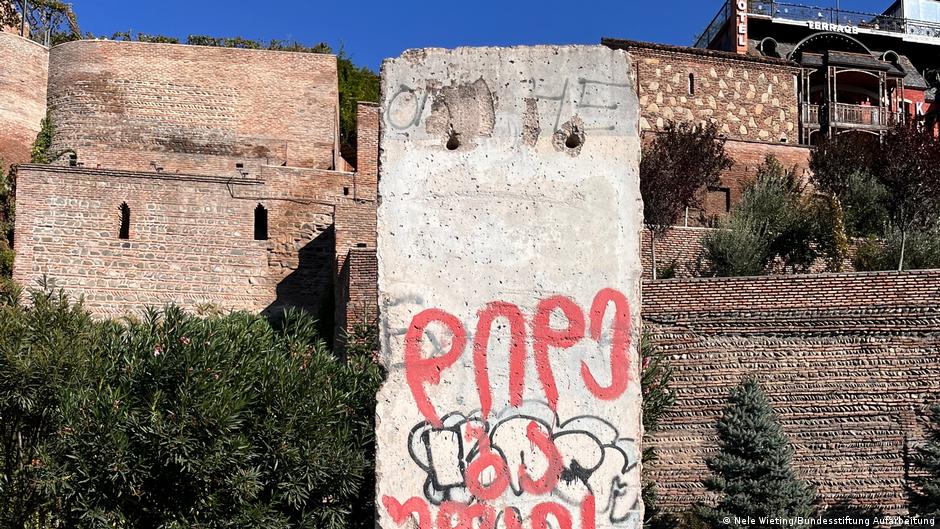
When the Berlin Wall fell, Berliners were eager to dismantle the repressive structure as quickly as possible. At the same time, individuals, governments, and institutions around the world were interested in acquiring parts of it. The USA, in particular, was very interested in preserving parts of the wall. According to estimates, there are more pieces of the Wall in the USA than in Berlin. Whether in front of the CIA headquarters in Langley or in a men’s room in Las Vegas, the Berlin Wall can be found all over the country.
Global Distribution of the Wall
Pieces of the wall are scattered not just across the United States but around the world – from New Zealand to Iceland and from Indonesia to Chile. The German Foundation has identified 57 countries (excluding Germany) where there is at least one piece. Everyone has their own story and everyone is interpreted differently. Sometimes it was private individuals or companies who purchased the segments, sometimes the federal government or the Berlin Senate donated them.
Symbolism and Meaning
In South Korea, where a connection to German history is felt through the country’s separation from the North, pieces of the Wall can be found in six different locations. The pieces of the Wall seem to have a special meaning in some countries of the former Eastern Bloc, where they symbolize the hard-won democracy. This is the case in Bulgaria, where the Sofia city administration asked the Berlin Senate for a piece of the wall in 2006. It now stands next to the Memorial to the Victims of Communism in Bulgaria.
Controversy and Criticism
After the fall of the Berlin Wall, the then-interim government of the GDR commissioned a state-owned company to sell the remains of the building for a profit. This sparked huge protests – that the GDR government, together with party representatives who had built the wall on which so many people died, now even wanted to make a profit from the sale. A work criticizing this practice is in the Norwegian city of Trondheim. There, the artist Lars O. Ramberg created a sculpture for the city administration entitled “Capitalist Realism”. He placed the word “SALE” on the wall segment.
Legacy of the Berlin Wall
In the last 10 years, requests for pieces of the wall have decreased significantly. “World history has moved on and world politics is different,” says Anna Kaminsky. "The iconic effect of the Wall has diminished over the decades. It is increasingly losing its status as a symbol." Some say that this also has its positive aspects – because no matter how colorful it is or where it is placed, the wall remains one symbol of dictatorship.
