

Introduction to the November Pogroms
“I can still remember the morning of November 10th,” said W. Michael Blumenthal. "My father was arrested early in the morning. In the midst of the tumult and despite my mother forbidding me to do so, I went outside unnoticed. I saw the broken shop windows on Kurfürstendamm and the smoke rising from the synagogue on Fasanenstrasse." Blumenthal was only 12 years old at the time.
Jews were Humiliated and Beaten
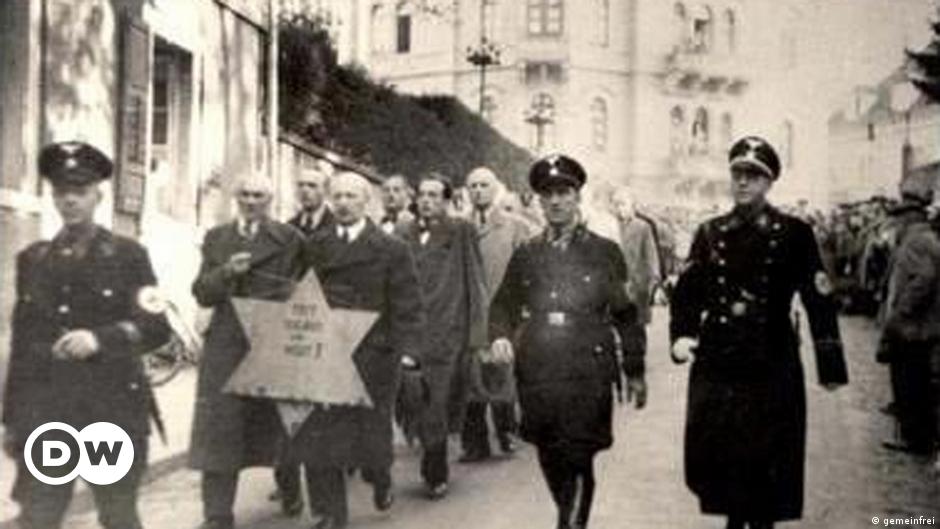
On the night of November 9, 1938, Jews across Germany and Austria fell victim to mob brutality: 1,300 synagogues and 7,500 businesses were destroyed and countless Jewish cemeteries and schools were devastated. Police watched as Jews were humiliated on the streets, beaten and, in at least 91 cases, murdered. The local fire departments were unable to prevent synagogues and Jewish shops from burning; they simply prevented the flames from spreading to neighboring buildings. And that was just the beginning. On November 10th, around 30,000 Jewish men were deported to the Dachau, Sachsenhausen, and Buchenwald concentration camps. Blumenthal’s father was among them.
Personal Accounts of the Pogrom
"I still remember my mother’s words as he was taken away by two police officers: ‘What’s wrong? What are you doing to him? What did he do?’ Where is he being taken?’” Blumenthal said. “Even as a 12-year-old you feel the fear of adults.” The rest of the Blumenthal family managed to escape to Shanghai in 1939. At the time, it was one of the few places where Jewish refugees could still enter without a visa.
The Pretext for the Pogrom
Physical attacks and intimidation against Jews have been widespread in Germany since the Nazis came to power in 1933. The Nuremberg Laws of 1935 determined who was considered a Jew, and many people were suddenly threatened with a professional ban. Other laws limited their access to public spaces. Many Jewish properties were expropriated and “Aryanized.” But “it is essential to understand November 1938 as a turning point in history,” said historian Raphael Gross. "After 1938, the so-called era of German Jewry was over. German society was different after that." The pretext the Nazis needed to justify the pogrom came when a Jewish teenager, Herschel Grynszpan, murdered German diplomat Ernst vom Rath in Paris on November 7.
Implementation of the Pogrom
Immediately after German radio reported the killing, anti-Jewish riots broke out in some cities. But two days later, systematic riots broke out across Germany – after Hitler personally gave the order. From Munich, where the entire Nazi leadership had gathered for the anniversary of the Beer Hall Putsch in 1923, Nazi Propaganda Minister Joseph Goebbels wrote a speech in which he ordered Jewish shops to be destroyed and synagogues set on fire. Police were ordered not to disturb the riots and firefighters were only to protect “Aryan” property. Looting was forbidden. The orders were implemented that night – not only in Berlin but also in Cologne, Hamburg, and Frankfurt as well as in small towns and villages throughout Germany.
The Aftermath and International Reaction
Despite the official ban, looting also occurred on November 9th and 10th. A report by the Brazilian Embassy Council speaks of gangs of young people who displayed cult objects stolen from synagogues. All diplomats stationed in Germany informed their home countries about the incidents. The reports described the events as “cultural barbarism.” The diplomats did not make any concrete demands or suggestions for action to their home governments. “They waited and falsely hoped that they could somehow come to terms with the Nazi regime,” said Hermann Simon. “In this respect, the response to the reports was relatively low.” No one foresaw the Nazis’ plans to exterminate the Jews. In a fatal misjudgment of the situation, the Italian embassy wrote on November 16, 1938: “It is inconceivable that one day 500,000 people will be alive.” [the approximate number of Jews living in Germany] are sent to the wall, sentenced to execution or suicide, or locked up in huge concentration camps.”
