

Introduction to the Power of Words
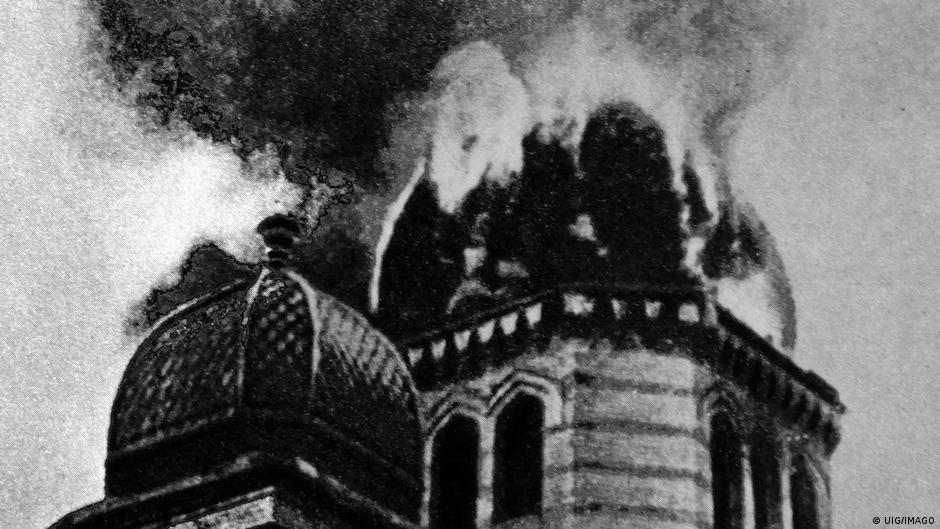
Words have meaning. They shape people’s attitudes towards a topic, remember events and react to developments that influence their lives. For decades, people in Germany have referred to the anti-Jewish violence that swept the entire country on November 9, 1938 as “Kristallnacht.” The translation “Night of Broken Glass” is widely used in English.
Origins of the Term "Kristallnacht"
Historians argue about the origins of the term “Kristallnacht,” but it has nevertheless entered the lexicon of German history as such “because its name comes from the shards of glass that lined the German streets,” according to the United States Holocaust Memorial Museum (USHMM) in Washington, DC. The sheer extent of damage, vandalism and looting on November 9, 1938 led to the events being dubbed the “Night of Broken Glass.”
The Problem with the Term "Kristallnacht"
The problem is that broken glass is hardly the worst consequence of a night of terror that many historians say was the beginning of the Holocaust and the systematic murder of millions of Jews and people of other groups. “The term obscures the atrocities committed against Jewish citizens,” Meier Schwarz, a German-born Holocaust survivor and Israeli academic who died in 2022, once wrote. According to the USHMM, hundreds of people were killed and 30,000 Jewish men were arrested and deported to concentration camps.
Call it What it Is
That night, rioters set fire to hundreds of synagogues and Jewish institutions across Austria and Germany. They desecrated Jewish cemeteries and looted thousands of Jewish shops. Then the Nazi authorities asked the Jews to pay for the damage. Given the scale and severity of the events, “Shattered Glass” does not reflect the extent of the brutality and suffering. By using more direct and explicit terminology, Germany aims to ensure that the historical record reflects the nature of the atrocities committed.
The Term "Pogromnacht"
A more appropriate term would be "pogrom," a Russian word derived from a verb meaning "to wreak havoc, to destroy violently." Therefore, “Pogromnacht” – the night of pogroms – has become more common in recent Holocaust discourse in Germany. “Kristallnacht” or its English equivalent remains in common use outside Germany, including by English-language media and Jewish organizations.
The Problem with the Term "Pogrom"
Not all historians are happy with this choice. They say "pogrom" is a general term that can refer to a series of acts of violence and persecution that Jews have faced throughout their history in Europe, particularly in the Russian Empire. But while these events were also traumatic and deadly, they did not rise to the level of systematic and state-sponsored terror in Nazi Germany. The coordination and planning was “so special under National Socialism” and incomparable.
Finding Words for the Unspeakable
The way people and societies view and engage with history changes over time, as does the vocabulary with which it is discussed. This is particularly true for Germany, whose present is constantly confronted with its past. Given the extremism of the Nazi era and the crimes against humanity that resulted, it may be impossible for historians, linguists and writers to ever find the right words to describe this level of horror and destruction. But trying to do just that is another way Germany maintains public awareness of its history. What matters is less the terms and more the content. “The most important thing,” is knowing what you’re talking about.
