

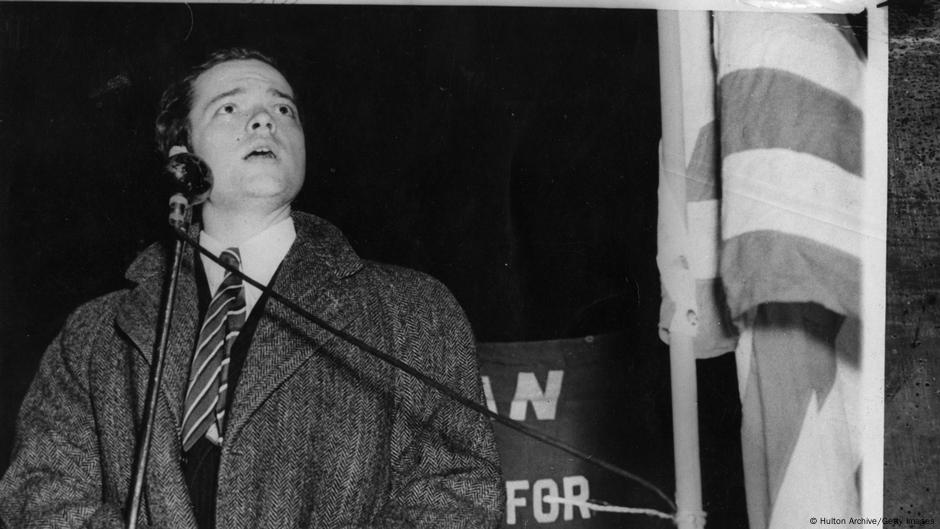
Introduction to a Radio Show that Shaped Media History
It was a radio show that shaped media history and brought 23-year-old Orson Welles to fame: his adaptation of HG Wells’ 1898 novel "The War of the Worlds." This year, on Sunday evening, October 30, listeners who tuned in to dance music on Columbia Broadcasting System (CBS) radio heard a news flash that interrupted “regular” programming. A series of unusual explosions had been observed on the planet Mars, and a lot of hydrogen gas was moving towards Earth.
The Show’s Broadcast and its Impact
The show focused again on dance music. Another news flash interrupted the orchestra to inform listeners that a strange object had landed in a field in rural New Jersey. The entire show, including music, aired during an episode of the radio series "Mercury Theater on the Air," in which Orson Welles adapted HG Wells’ 1898 science fiction novel "War of the Worlds." The live radio broadcast depicted a Martian invasion in graphic detail, with Welles employing the latest tricks familiar to radio stations: interrupting programs with "special bulletins," using "experts" to lend credibility to the incredible news, and providing emotional timeliness from the scene of the events.
The Panic Caused by the Show
The alien invaders appeared unstoppable as they used their heat rays to burn entire armies and send clouds of suffocating gas into New York City. The national broadcast reportedly caused mass panic in several cities. Orson Welles and his Mercury Theater troupe probably only aimed to entertain, not to deceive. But the show needs to be seen in the context of the time in which it was made. The world lived in fear that Germany was preparing for war. Across the Atlantic, in England, families conducted gas mask drills. As the broadcast continued, people called the police and claimed they could see smoke in the distance coming from the battle with the aliens.
The Aftermath of the Show
Other people even reported to the police that they had seen the invading Martians. Some claimed that it was not the Martian invasion but the Germans. But the real “fake news” broke the day after, when newspapers added to the panic and hysteria the broadcast had caused. This mass panic has now entered the public consciousness – even if studies suggest that it was greatly exaggerated. According to Michael Socolow, associate professor of communications and journalism at the University of Maine, the newspapers saw an opportunity to discredit radio.
The Power of a Joke
The idea of a new medium scaring people with an incredible and sensational show is something we like to hear. It’s almost like a conspiracy theory. But I think the other reason we really like it is: it makes us laugh at audiences in the past and think that they were somehow much more naive than we are today. An episode of New York public station WNYC’s acclaimed program "Radiolab," marking the 75th anniversary of Welles’ broadcast, said the hoax was repeated in Quito, Ecuador, in 1949. This time the panic was real. The streets filled with people screaming and praying.
Internet and Social Media: Ideal Means for Spreading “Fake News”
The army raced through the city in trucks and tanks to fight the Martians, adding to the panic. When the show ended and people realized they had been deceived, fear turned to anger and the crowd stormed the radio station, throwing rocks and breaking windows before setting fire to the building. Six people were killed. Today, the Internet and social media represent a new communication medium that has not established the same level of credibility as more traditional media. This makes them ideal vehicles for the spread of “fake news” in today’s world.
The Lesson Learned
The Welles broadcast sparked the first serious investigations into media credibility. “It really sparked one of the greatest discussions about media literacy in American history,” he says. Although Welles said in 1938 that the production was intended purely as entertainment, he revealed in a 1955 interview with the BBC that his motivations were quite different. “When we did the Mars broadcast, we got tired of how everything that came through this new magic box, the radio, was being swallowed up," he said. "In a way, our show was an attack on the credibility of this machine.
Conclusion
We should constantly be aware and think about what it means to trust our sources of information. And especially in an algorithmic universe where social media platforms only curate our schedules to show us things they think we want. Now it’s up to us, the user or the viewer or the reader, to be much more skeptical, and we need to discuss media literacy more. That’s what Welles was getting at. The rise of AI-generated deepfakes may lead to an even greater loss of public trust in the media and democratic institutions.
