

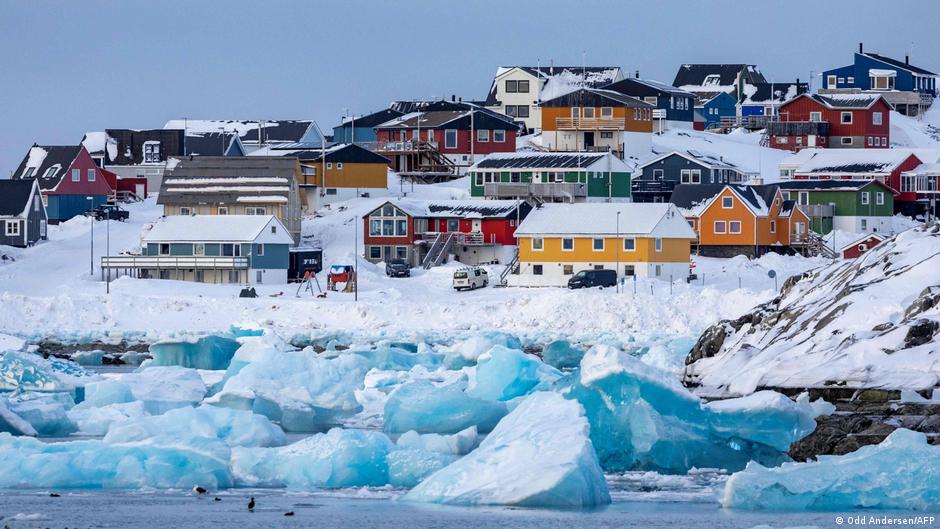
Introduction to Greenland
Before Donald Trump expressed interest in this Arctic Circle island, it wasn’t exactly in the global spotlight. All that changed when the US president insisted: “We must have Greenland.” But it is not the first time that the largest island in the world has been so sought after.
Early Migration and Erik the Red
The first people settled in Greenland around 4,500 years ago. They came from the North American continent. In the 12th century they were gradually displaced by Asian immigrants, the Thule people, who came to the island from Siberia via the Bering Strait. Their descendants are the Inuit, from whom most of today’s 56,000 Greenlanders descend.
The island owes its name to the Viking explorer Erik the Red. According to Icelandic legends, he was banished from Iceland around 982 for manslaughter. He and his followers sailed west and reached the Arctic island. To promote settlement, he called it Grœnland, i.e. “green land”. While much of Greenland is covered in ice, parts of the coastal areas were relatively green at the time.
A historical map of Greenland shows the coastline in green; The name was chosen by the Viking Erik the Red to entice people to move there. The Norse settlements existed in Greenland for about 400 years before disappearing completely. In the 15th century the Inuit were again the island’s only inhabitants. However, legends persisted in the Nordic world about the lost Nordic settlers of Greenland, who lived deep in the southern fjords and had great wealth.
A Priest Paves the Way for Danish Colonization
These stories reached Hans Egede – a Norwegian priest who believed that Nordic settlers might be living in Greenland and needed spiritual guidance. On July 3, 1721, his ship anchored off the coast of Greenland after a two-month voyage. Egede found no surviving Norse communities. Instead, he encountered Inuit populations who followed their own spiritual traditions. He began efforts to convert them to Christianity, which he viewed as his religious mission.
He also learned the Inuit language and studied local customs. Since bread was unknown in Greenland at the time, he adapted Christian texts to local conditions and rewritten the line "Give us today our daily bread" in the Lord’s Prayer to "Give us today our daily seal." Three years after his arrival, Egede baptized the first Inuit child. He founded a church and helped lay the foundation for what would become Greenland’s capital, Nuuk.
Norwegian-Danish Dispute: Who Owns Greenland?
When Hans Egede arrived in Greenland in 1721, he raised the Danish flag, reflecting the political reality of the time: Denmark and Norway had been united under a single crown since 1380, a personal union that lasted until 1814. When that union ended, Greenland remained under Danish rule – a decision contested by Norway. Tensions escalated in 1931 when Norway occupied parts of Greenland and declared the area “Eirik Raudes Land” after Erik the Red.
Denmark challenged the move and the dispute was taken to the Permanent Court of International Justice in The Hague. In 1933, the court ruled that sovereignty over all of Greenland belonged to Denmark, thus ending the territorial dispute.
How the USA Came into Play
In the 19th century, the United States pursued an expansionary foreign policy. It purchased Louisiana from France in 1803, Florida from Spain in 1819, and Alaska from Russia in 1867. Secretary of State William H. Seward, the architect of the Alaska Purchase, also expressed interest in acquiring Greenland, seeing it as strategically important relative to Canada.
However, Congress was reluctant to take on what it saw as the high cost of an ice-covered and sparsely populated territory. Instead, in 1916, the United States purchased the Danish West Indies—now the U.S. Virgin Islands—for $25 million. As part of the agreement, Washington officially recognized Danish sovereignty over Greenland.
World War II and the Cold War
When Nazi Germany occupied Denmark during World War II, Denmark’s direct control over Greenland was effectively interrupted. In 1941, the Danish ambassador to Washington, Henrik Kauffmann, signed an agreement with the United States. Under its terms, the United States would supply and defend Greenland while gaining the right to establish weather stations and military bases on the island. The Inuit population of Greenland was not surveyed.
In 1946, a year after the end of the war, the United States offered Denmark $100 million in gold to purchase Greenland to secure its strategic position at the start of the Cold War. The administration of President Harry S. Truman viewed the island as geopolitically important given its location in North America and its importance in the defense of the Arctic.
Colonial Injustice and the Desire for Independence
In 1953, Greenland’s status changed from a Danish colony to an integrated part of the Kingdom of Denmark. The island received two seats in the Danish parliament, but the decision-making power remained largely with Copenhagen. The Danish authorities pursued a policy aimed at the rapid “modernization” of Greenland’s hunting and fishing society.
This included promoting the Danish language, education and social norms. Nomadic lifestyles were abolished and many Inuit were resettled in larger cities. One of the most controversial measures took place in the early 1950s, when 22 Inuit children were taken from their families and sent to Denmark. The aim was to give them a “Danish” education and later bring them into leadership positions in Greenland.
In 1979, Greenland received its own parliament and government, but with limited powers. An important step followed in 2009, when control of most internal affairs was handed over to Greenland. Above all, Denmark retained responsibility for foreign and security policy. Today, support for full independence from Denmark remains strong in Greenland. What Greenlanders overwhelmingly reject is joining the United States. Recent polls have shown that 85% oppose any US takeover.
