

Introduction to Berlin’s Hidden Past
It’s often little things that reveal something about times gone by. Eberhard Völker, an archaeologist at the State Office for Monument Preservation, and his colleagues suspect that goat brains were a popular snack in the Middle Ages. This theory is based on the discovery of sawn-open goat skulls that often turn up in the ground beneath Berlin.
Uncovering the Past
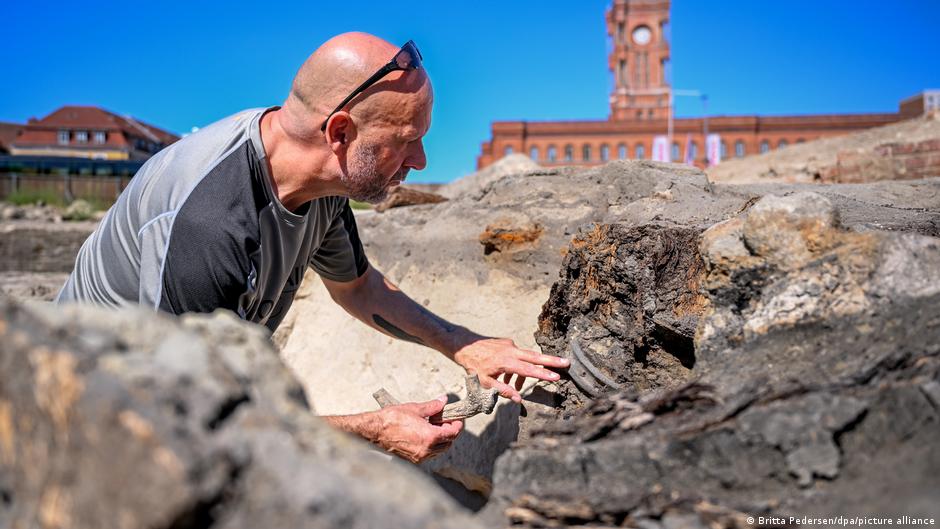
Völker leads excavations at the Molkenmarkt in the historic center of Berlin, digging into the past with a shovel, trowel, and broom. At a depth of 4 meters, researchers reach the Middle Ages. The ground level in Berlin has risen by exactly 4 meters in 800 years due to fire rubble and debris. The Molkenmarkt is one of the largest inner-city excavations in Germany, measuring over 22,000 square meters. Once the asphalt and concrete are removed, archaeologists can begin meticulously combing the earth beneath.
Toilet Treasures
Researchers have been working at the Molkenmarkt since 2019, unlocking the earth’s secrets. They have already found 750,000 individual pieces, including a thick wooden plate in good condition but with a terrible smell, having spent centuries in a latrine. Organic materials such as wood, textiles, and leather resist decay when deprived of oxygen, making old toilets and dry wells a treasure trove for archaeologists.
Rare Finds
Völker’s favorite find is a small clay figure of Saint Catherine, which probably decorated a home altar to protect the family from misfortune. Other valuable items include a rare gold ring with garnet, a bone flute from the 14th century, and an inconspicuous brown piece of silk that bears witness to trade with China in the first years of Berlin’s existence.
PETRI: A Home for Berlin’s Treasures
The Molkenmarkt is considered the oldest market in Berlin, and Völker and his colleagues are bringing to light a hidden archive of the city’s history. The archaeologist conducts regular tours of the site, which are always fully booked. All finds are subjected to thorough scientific documentation, analysis, and interpretation, creating a huge data repository of Berlin’s past.
A New Museum
The items found at the Molkenmarkt don’t have to travel far, as they are taken to PETRI, a new museum that opened in summer 2025. PETRI is built on the walls of the medieval St. Peter’s Church and a Latin school, the foundations of which are exhibited in the basement. The museum is already popular with both school classes and foreign tourists, offering a chance for Berlin to show that it has other stories to tell besides the usual ones.
A New Resting Place for the Dead
In the basement of the PETRI museum, there is a surprise: a bouquet of fresh flowers is placed in front of a wall, with the inscription "May angels lead you to paradise." The St. Peter’s Church complex once included an old cemetery, and the remains of hundreds of people were exhumed during the excavations and ceremoniously reburied in an ossuary. The skeletal remains of some of Berlin’s first residents are kept in drawers, telling life stories, albeit anonymously.
Berlin’s Birthday
Scientific bone analyzes have shown that Berlin is much older than previously thought. The city’s 800th birthday is scheduled to be celebrated in 2037, but it is obvious that this milestone birthday actually dates back several decades. From the PETRI roof terrace, you can see the roaring traffic and the built-up city center of Berlin, with the medieval roots of the city lying just a few meters deeper.
