

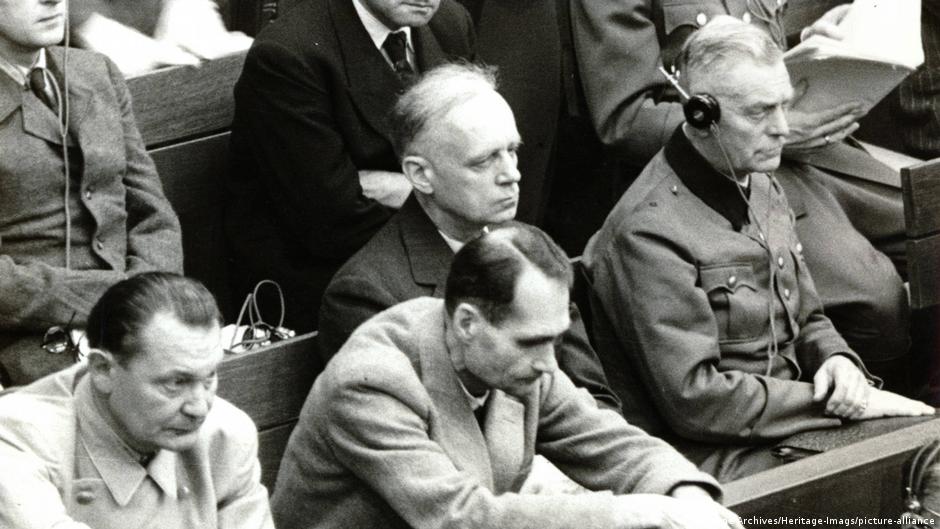
Introduction to the Nuremberg Trials
The Nuremberg Trials began on November 20, 1945, in Courtroom 600 of the Nuremberg Palace of Justice, where chief prosecutor Robert H. Jackson read out a list of names of high-ranking representatives of the Nazi state accused of crimes against peace, war crimes, and crimes against humanity. Over the next 218 days, more than 230 witnesses were interviewed, and 300,000 statements were read, resulting in 16,000 pages of transcripts. The choice of Nuremberg as the place of jurisdiction was not arbitrary, as it had previously been the site of the Nazi party rallies and the promulgation of the Nuremberg Laws, which paved the way for the Holocaust.
The Crimes Could Not Go Unpunished
The victors over Germany – the USA, Great Britain, France, and the Soviet Union – agreed that the crimes of the Third Reich must not go unpunished. Millions of people fell victim to the Nazi regime, murdered in concentration camps, through war, hunger, enslavement, and forced labor. The Nuremberg Trials were the first time that leading representatives of a state were held personally responsible for their inhumane acts, setting a new precedent in international law.
No One Pleaded Guilty
As the trials began, one defendant after another pleaded not guilty. They claimed that they had only followed orders and were not responsible for the atrocities committed. Hermann Göring, one of the most powerful figures in Nazi Germany, protested his innocence, stating that he had not known about the extermination of the Jews. Walther Funk, Hitler’s personal press chief, denied any wrongdoing, despite having ordered the valuables of murdered Jews to be sent to the Reichsbank.
The Verdict
The first Nuremberg trial ended on October 1, 1946, with the court handing down twelve death sentences, seven prison sentences, and three acquittals against high-ranking Nazi leaders. The evidence was overwhelming, with films from concentration camps, statements from survivors, and letters and orders from the perpetrators. The trials marked a significant milestone in the pursuit of justice for the victims of the Nazi regime.
The German Public’s Reaction
The German public viewed the trials as "victor’s justice," with many believing that the defendants were being unfairly punished. The trials established a narrative among the German population that the Nazi regime was responsible for the atrocities, but that the average German was not to blame. This perspective was adopted by many Germans, who saw themselves as victims of the Nazi regime rather than perpetrators.
The Legacy of the Nuremberg Trials
The Nuremberg Trials are now considered a milestone in international law, marking the first time that leading representatives of a state were held personally responsible for their actions. The trials paved the way for the establishment of the International Criminal Court (ICC) in 1998, which aims to prosecute individuals for war crimes, crimes against humanity, and genocide. However, the ICC has faced challenges in enforcing its authority, with many countries refusing to recognize its jurisdiction.
The International Criminal Court: A Paper Tiger?
The ICC has been criticized for being a "paper tiger," with many countries ignoring its arrest warrants. The court’s inability to enforce its authority has been demonstrated by the fact that many leaders accused of war crimes have been able to travel freely, despite being wanted by the ICC. The ICC’s limitations have raised questions about its effectiveness in holding individuals accountable for international crimes.
Challenges Facing the International Criminal Court
The ICC faces significant challenges in enforcing its authority, including the lack of recognition from major powers such as the USA, Russia, China, and India. The court’s inability to prosecute heads of state for war crimes, unless the country in question recognizes the ICC, has also limited its effectiveness. Furthermore, the ICC relies on the cooperation of member states to bring suspects to justice, which can be inconsistent. Despite these challenges, the ICC remains an important institution in the pursuit of international justice, and its establishment is a direct result of the legacy of the Nuremberg Trials.
