

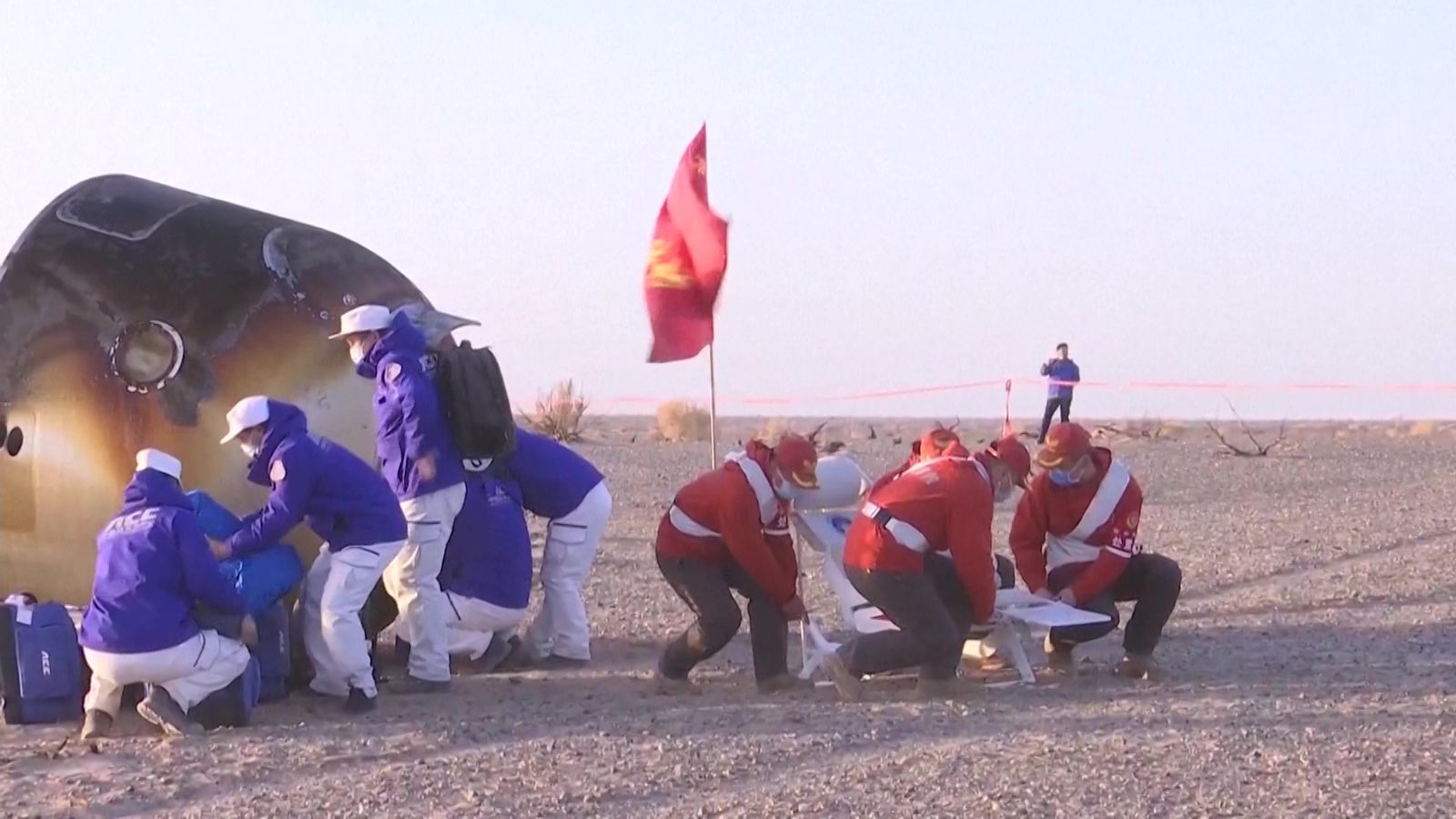
Successful Return to Earth
Three Chinese astronauts have successfully returned to Earth from their country’s space station after their capsule was damaged. The team deployed a red-and-white striped parachute during their descent before landing at a remote location in Asia’s Gobi Desert on Friday.
The Astronauts
Astronauts Chen Dong, Chen Zhongrui, and Wang Jie were scheduled to return on November 5 to complete their six-month rotation on the Tiangong space station. However, their return journey was delayed by nine days due to tiny cracks found in the Shenzhou-20 return capsule they were supposed to travel on.
Cause of the Delay
The cracks were most likely caused by the impact of space debris hitting the spacecraft, according to China’s space agency. Space debris, which consists of millions of pieces of mostly tiny particles orbiting the Earth at high speeds, can arise during launches and collisions and pose a danger to satellites, space stations, and astronauts operating outside them.
Alternative Arrangements
Since the Shenzhou-20 was out of action, the crew used a Shenzhou-21 aircraft that had brought a three-man replacement crew to the station in April. The Chinese space agency said the stranded taikonauts remained in good condition throughout.
The Tiangong Space Station
The first module of Tiangong, which means “Heavenly Palace,” was put into operation by the Chinese state in 2021. It is smaller than the International Space Station, which Beijing is barred from accessing due to U.S. national security concerns.
China’s Space Program
China’s space program has developed steadily since 2003. As part of a long-term plan to improve its orbital capabilities, China plans to land a human on the moon by 2030 and has already explored Mars with a robotic rover. The Asian country’s recent space mission also brought four mice to study how weightlessness and confinement would affect them, which will help learn key technologies for breeding and monitoring small mammals in space.
