

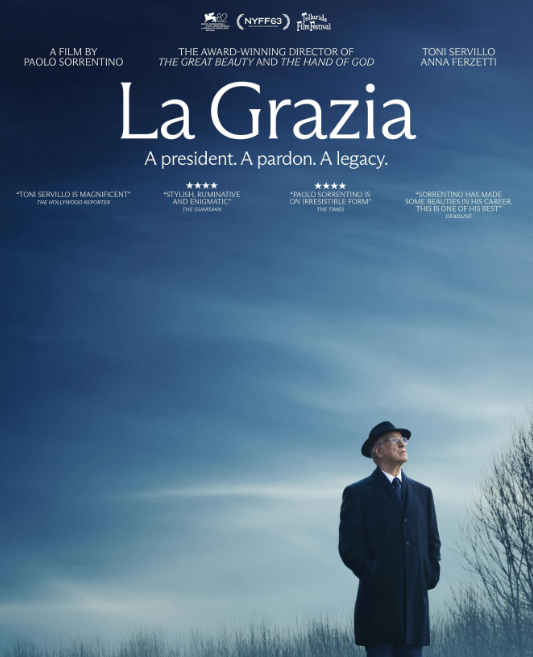
With La Grazia, Paolo Sorrentino returns to familiar yet fertile ground: the intimate psychology of power, observed not through spectacle but through restraint. Opening the Venice Film Festival, the film marks a decisive recalibration after the divisive Parthenope. Here, Sorrentino exchanges flamboyance for precision, crafting a somber, ironic meditation on leadership, morality, and the loneliness that accompanies institutional authority.

At the center stands Toni Servillo, once again Sorrentino’s essential cinematic counterpart. Servillo plays Mariano De Santis, the President of Italy nearing the end of his mandate—an emblem of integrity admired for his constitutional rigor and emotional opacity. Nicknamed “reinforced concrete,” Mariano embodies legality without warmth, order without consolation. Servillo’s performance is a masterclass in subtraction: a flicker of doubt, a restrained smile, a pause heavy with unspoken fear. In his stillness, the film finds its pulse.
Unlike the operatic excess of The Great Beauty or the corrosive satire of Il Divo, La Grazia unfolds in muted tones. The Quirinale Palace becomes less a seat of power than a mausoleum of certainty, its corridors echoing with unresolved questions. Mariano is confronted with decisions that refuse moral clarity: pardons involving mercy and violence, and a proposed euthanasia law that pits legal responsibility against human suffering. Sorrentino refuses easy answers, allowing the dilemmas to linger—much like the president himself, paralysed by conscience and faith.
Yet politics is only the film’s outer shell. Beneath it lies an intensely personal anguish. Mariano is haunted by the suspicion that his late wife once betrayed him—an unknowable truth that undermines his lifelong devotion to facts and statutes. The irony is devastating: a man who built his life on legal certainty is undone by emotional ambiguity. This private torment, rendered with dry humor and aching melancholy, gives La Grazia its quiet force.
Visually, the film is elegant and austere, favoring composed interiors and controlled movement. Moments of surreal tenderness puncture the formality—a ceremonial reception disrupted by rain and wind, a sudden burst of song among veterans—images that crystallize Sorrentino’s view of power as both absurd and fragile. Music, contemporary and anachronistic, slips in like a guilty pleasure, hinting at a vitality Mariano has long suppressed.
Ultimately, La Grazia is not a portrait of political failure but of existential fatigue. It asks what remains when authority recedes and identity dissolves. In returning to Servillo, Sorrentino reconnects with a cinematic language rooted in irony, compassion, and doubt. The result is a film of measured beauty—less intoxicating than his earlier triumphs, perhaps, but richer in reflection. It is a work that trusts silence, embraces uncertainty, and finds, within restraint itself, a form of grace.
La Grazia premiered in Competition at the Venice Film Festival.
By Michel Riet – Venice 2025
